
The Awareness Logic of Ambiguity (ALA): A New Framework for Triadic Interpretive States in Decision-Making and Artificial Intelligence

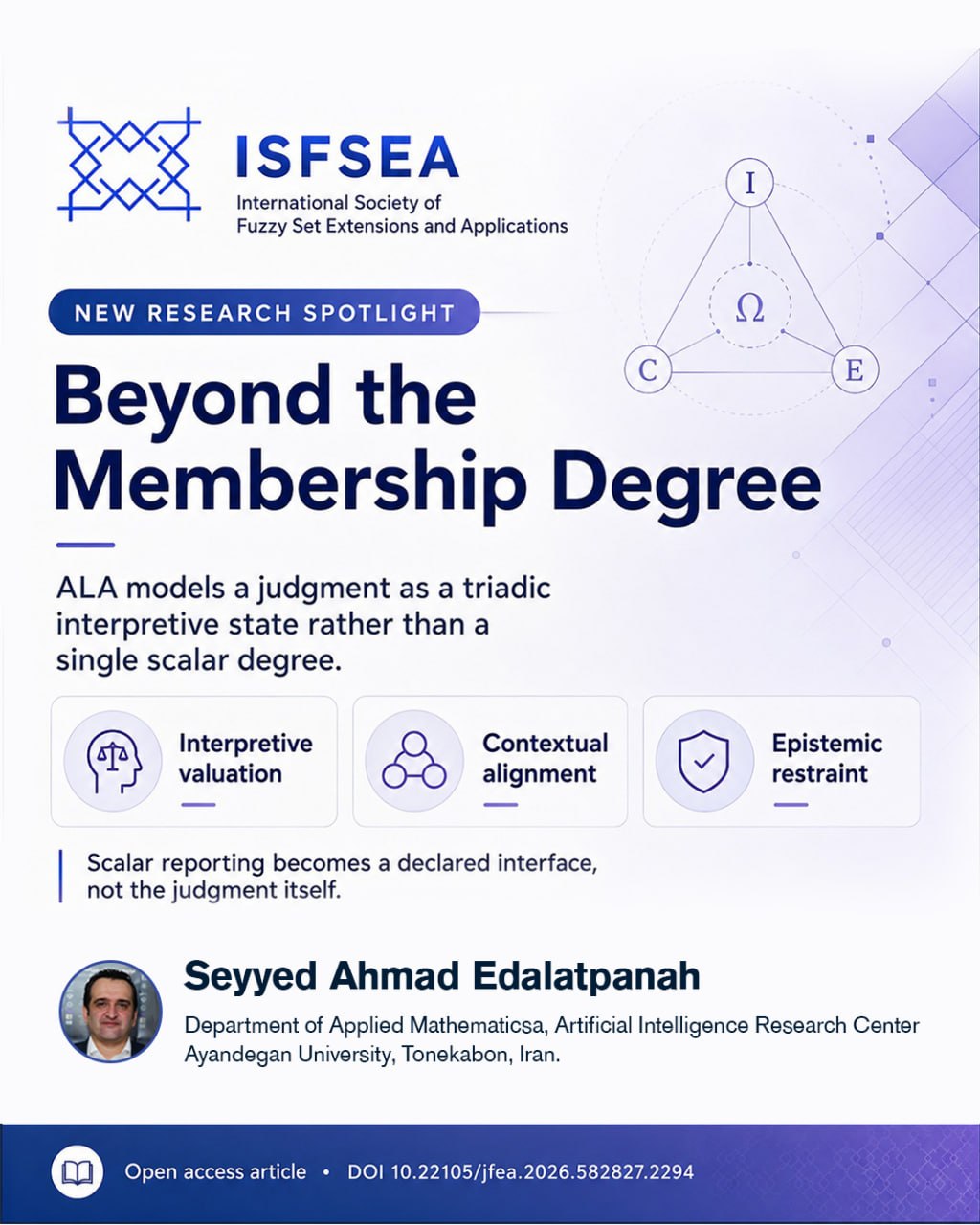
The increasing complexity of decision-making under uncertainty has created a growing demand for mathematical frameworks capable of representing not only degrees of support but also contextual relevance and epistemic limitations. Addressing this challenge, Dr. Seyyed Ahmad Edalatpanah introduces The Awareness Logic of Ambiguity (ALA), a novel theoretical framework that models ambiguity through triadic interpretive states while preserving their semantic roles during mathematical operations.
Published in the Journal of Fuzzy Extension and Applications, this research proposes a formal architecture that extends traditional approaches to uncertainty representation without replacing established fuzzy set theories.
Introducing the Triadic Interpretive State
Unlike classical fuzzy models that typically rely on a single membership degree, ALA represents information using a three-component interpretive state:
A = (θ, σ, γ)
where:
- θ (Interpretive Valuation): Represents the degree of interpretive support.
- σ (Contextual Alignment): Measures how well an interpretation fits its surrounding context.
- γ (Epistemic Restraint): Indicates the level of epistemic caution before making a commitment or decision.
A defining characteristic of ALA is that these three coordinates possess distinct, non-interchangeable semantic roles. Rather than functioning as parallel truth degrees, each component captures a unique dimension of reasoning.
A Distinct Perspective on Epistemic Restraint
One of the framework’s most innovative features is the treatment of epistemic restraint. Unlike conventional confidence measures, the epistemic restraint coordinate operates with reversed operational polarity:
- Higher epistemic restraint corresponds to lower readiness for commitment.
- Lower restraint indicates a greater willingness to act on available information.
This distinction enables ALA to separate three fundamentally different concepts:
- Strength of interpretive support
- Contextual adequacy
- Epistemic readiness for decision-making
Such separation provides a richer representation of ambiguity in uncertain environments.
Mathematical Foundations of the ALA Framework
The paper develops a comprehensive mathematical foundation for triadic interpretive states, including:
- Cognitive partial ordering
- Bounded distributive lattice structures
- Role-preserving algebraic operations
- Admissible scalar projection methods
- Aggregation mechanisms for combining interpretive states
These mathematical structures ensure that each semantic component maintains its intended meaning throughout computational processes.
The Non-Collapse Theorem
A major theoretical contribution of the paper is the Non-Collapse Theorem.
This result demonstrates that two different triadic states may produce the same scalar projection while exhibiting different behaviours under valid lattice operations. Consequently, scalar coincidence does not imply operational equivalence.
This finding highlights an important limitation of scalar-only representations and reinforces the value of preserving multidimensional interpretive information.
Relationship with Existing Fuzzy Set Extensions
ALA is not proposed as a replacement for classical fuzzy sets or their established extensions. Instead, it complements existing theories by providing a formal architecture for scenarios where:
- Interpretive valuation
- Contextual alignment
- Epistemic restraint
must remain separate until the final stage of scalar reporting.
This makes the framework particularly suitable for applications involving uncertainty, ambiguity, and context-sensitive reasoning.
Future Research Directions
The proposed framework opens several promising research opportunities for the fuzzy systems community, including:
- Comparative analysis with Intuitionistic Fuzzy Sets
- Pythagorean Fuzzy Sets
- q-Rung Orthopair Fuzzy Sets
- Neutrosophic Sets
- Bipolar and Hesitant Fuzzy Models
- Context-aware uncertainty representations
- Novel distance, similarity, entropy, and divergence measures
- Aggregation operators for multi-criteria decision-making
- Connections with Z-Numbers and Three-Way Decision Theory
- Applications in risk-sensitive decision analysis
- Medical reasoning under uncertainty
- Artificial Intelligence-assisted decision-making
These directions position ALA as a promising foundation for future theoretical developments and practical applications.
Article Information
Author: Seyyed Ahmad Edalatpanah
Title: The Awareness Logic of Ambiguity (ALA): Triadic Interpretive States and Their Structure-Preserving Operational Core
Journal: Journal of Fuzzy Extension and Applications
Volume: 7
Issue: 2
Year: 2026
Pages: 661–702
DOI: https://doi.org/10.22105/jfea.2026.582827.2294
Final Remarks
The International Society of Fuzzy Set Extensions and Applications (ISFSEA) welcomes technically grounded discussions, comparative studies, formal extensions, application-oriented investigations, and critical evaluations of the ALA framework. By introducing a mathematically rigorous approach to preserving interpretive semantics, ALA contributes a valuable perspective to the ongoing evolution of fuzzy systems, uncertainty modelling, and intelligent decision-making.